
Weekly Exclusives
Weekly Exclusives - a newsletter that contains author publications, interviews, exclusive comments, photos and videos.
Photos and videos of the week
In the 65th Separate Mechanized Brigade, professional training sessions were held to improve the qualifications of anti-tank guided missile operators. Today, the operators conducted training firings with third-generation Javelin ATGMs.

How the defenders dived into a hole on Epiphany and competed in the cold
Interview
Serhii Cherevatyi, Ukrinform CEO

In recent weeks, the core of our political life has been concentrated around yet another peace plan, with which we—and the world—nurture hopes of ending the full-scale war in Ukraine, barbarically launched by the Russian aggressor.
Here Ukrinform offers you an analytical perspective from an eyewitness to how an already signed peace plan—one of Trump’s peace initiatives—actually works and is being implemented in practice. At the invitation of the Ministry of Foreign Affairs of Israel, Ukrinform’s Director General, Serhii Cherevatyi, visited that country. Having recently returned from the working trip, he analyzed how the country is living today, what has changed since the peace summit, why Israel is losing part of the information warfare despite its military successes, how the war in Ukraine, the shared enemy—Russia and Iran— are viewed there, and what their expectations are from the “peace plan” for our own country, since the lessons from Israel’s experience are important for Ukraine.
Oleh Didenko, Chair of the Central Election Commission of Ukraine

The issue of elections has rapidly surged to the top of Ukraine’s political agenda. Following President Volodymyr Zelensky’s statement that a Peace Agreement could be ratified through a nationwide referendum, and that presidential elections might be held simultaneously, the key question has resurfaced: is Ukraine capable of organizing elections within a short timeframe after the end of hostilities?
This was the central focus of Ukrinform’s conversation with Oleh Didenko, Chairman of the Central Election Commission (CEC) of Ukraine.
Sinan Ülgen, Director of the Center for Economics and Foreign Policy Studies (EDAM)

Developments of recent months demonstrate a fundamental transformation of the European security order, as the United States is reassessing its role within NATO and increasingly expects Europe to ensure its own security, while the “security umbrella” that the USA has provided to Europe for decades may close at any moment. Washington’s outlook on European security is changing, the credibility of collective defence mechanisms has become a subject of debate, and Russia’s aggression against Ukraine is already posing a threat to European countries as well.
At the same time, amid the growing disconnect between the United States and Europe, a new window of opportunity is opening for Türkiye. Ankara remains one of the most capable between NATO partners in terms of military capabilities and deterrence, and its role in shaping a new European security architecture is therefore increasing. Yet this situation also entails risks, as the credibility of US security commitments remains a key element in deterring Russia.
We spoke with Sinan Ülgen, the director of the Istanbul-based think tank, Center for Economics and Foreign Policy Studies (EDAM), and a visiting scholar at Carnegie Europe in Brussels, about the stage at which the transformation of European security currently stands, the role Türkiye can play in it, the possible security guarantees for Ukraine involving Türkiye, and why deterrence remains the only effective approach to Russia.
Publications
Absolute Resolve - Trump’s Tactical Triumph. What Comes Next?

The U.S. military operation in Venezuela on January 3, which resulted in the abduction of Nicolás Maduro and his wife, became an event of global proportions. For some, it appeared as a long-awaited act of justice and a demonstration of the power of international law; for others, it was a shocking and alarming precedent of direct forceful intervention.
Global reactions are polar opposites. Some governments and experts speak of the restoration of justice where sanctions and diplomatic pressure had failed for years. Others warn that such actions undermine the remnants of international legal norms and legitimize the use of force to resolve political issues.
For Ukraine, despite its geographical remoteness from Latin America, this event may have indirect but potentially significant implications. It is not only about the precedent of forcibly removing an authoritarian regime, but also about the signal it sends: in a world where international institutions are increasingly powerless, force is once again becoming the decisive argument. How this signal will be interpreted—in Kyiv, Moscow, and other capitals—remains to be seen.
Forecasts suggest the war will not be over in 2026, but its intensity will be shifting from high-intensity combat toward a lower-level, protracted phase

The so-called “diplomatic holidays” were effectively cancelled over the festive period “in the name of peace.” There is cautious hope that this effort may yield results, though doubts remain. For now, the war continues.
A Danish Mission: From the Trenches to the Runway


Danish engineer Lasse Werner Madsen lost his right leg above the knee as a teenager. At the time, active leg prostheses, a whole new technology, were effectively inaccessible, so he had to rely on an improvised device assembled by his prosthetist.
Later, frustrated by how difficult it was to obtain a modern active prosthesis, Lasse—by then an engineer with a decade of professional experience—devoted two years to developing his first prosthetic solution in collaboration with leading engineers from the Technical University of Denmark. Today, his innovations support not only people worldwide who have undergone amputations, but also Ukrainian veterans.
This support goes beyond everyday functionality. This year, Ukrainian veterans using prostheses developed by the Danish engineer walked the runway at Ukrainian Fashion Week.
Ukrinform spoke with Lasse about how he founded the venture and how his work is helping Ukrainians.
Fact Checks
“Special Valdai operation”: How Kremlin trying to sabotage peace talks with fake drone attack claims
On Sunday, December 28, at the Mar-a-Lago residence in Florida, U.S. President Donald Trump and Ukrainian President Volodymyr Zelensky held multi-hour negotiations on resolving the war in Ukraine. After a two-hour closed-door meeting, both presidents held a press conference announcing significant progress toward peace in Ukraine.
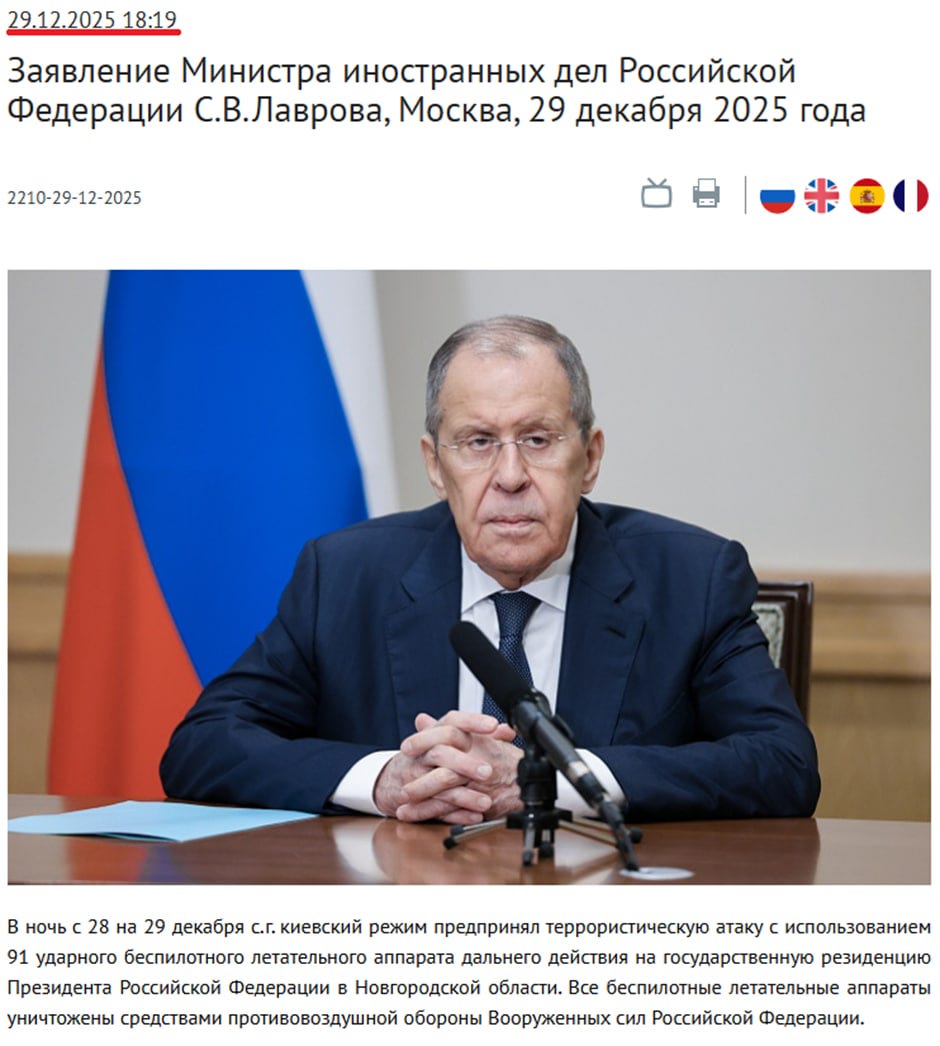
The following day, December 29, Russian Foreign Minister Sergey Lavrov claimed that 91 drones had allegedly attacked Vladimir Putin’s residence in Valdai, Novgorod region. Afterward, Putin’s advisor Yuriy Ushakov stated that “Trump was shocked and outraged by the attempted Ukrainian attack on Putin’s residence” and that the U.S. administration “thankfully did not provide Tomahawks to Kyiv.”
WAS THERE A DRONE ATTACK?
The so-called attack on Putin’s Valdai residence is reported only by Russian officials. No evidence has been presented to support it.
Moreover, these claims contradict data from the Russian Ministry of Defense. Initially, at 6:44, the MoD reported shooting down 89 Ukrainian drones overnight between December 28-29, of which only 18 were in the Novgorod region; later, at 8:30, they reported 23 more drones downed. The Ministry of Defense only mentioned the “attack” on the Valdai residence at 20:29 – more than two hours after the Russian Foreign Ministry’s statement.


Local residents also confirmed that no drone attack occurred. The Russian opposition outlet Point Media interviewed 14 residents of the Novgorod region, all of whom reported that they had not received any drone alerts, nor heard the sounds of drones or explosions.
Analysts at the Institute for the Study of War (ISW) also refuted the claims. They noted that the alleged strike on Putin’s residence lacks the typical signs of verified Ukrainian attacks, which are usually documented in open sources: videos with geolocation, flashes, fires or smoke near targets, and statements from local or regional Russian officials who typically downplay strikes.
RUSSIANS INVENTED TRUMP’S REACTION
After Lavrov’s statements, Russian media narratives began claiming that Trump was allegedly outraged by the attempted Ukrainian attack on Putin’s residence and that the U.S. administration was glad not to have supplied Tomahawks to Kyiv.
However, the source of these claims is Yuriy Ushakov, a longtime aide to Putin who oversees the Kremlin’s foreign policy. Neither Donald Trump nor any White House representative confirmed these statements.
The only official reaction from the U.S. President to Russian claims came during a meeting with Israeli Prime Minister Benjamin Netanyahu:
“No, I really don’t know about it. I’ve only heard about it, but I don’t know. That would be very bad. That would not be good,” Trump said when first asked about the attack.
Minutes later, while summarizing his morning call with Moscow, Trump revised his statement:
“You know who told me about it? President Putin told me. Early in the morning, he said he had been attacked. I was very angry about this,” he said. He also noted that the information about the attack itself still needed verification, meaning he acknowledged receiving a report but did not publicly confirm its authenticity.
UKRAINIAN RESPONSE
Ukraine immediately denied that any attack occurred on Putin’s residence in Russia’s Novgorod region. President Volodymyr Zelensky called Lavrov’s claims fake in his social media posts:
“This alleged ‘residence strike’ story is a complete fabrication intended to justify additional attacks against Ukraine, including Kyiv, as well as Russia’s own refusal to take necessary steps to end the war. Typical Russian lies. Furthermore, the Russians have already targeted Kyiv in the past, including the Cabinet of Ministers building. Ukraine does not take steps that can undermine diplomacy. To the contrary, Russia always takes such steps. This is one of many differences between us. It is critical that the world doesn’t stay silent now. We cannot allow Russia to undermine the work on achieving a lasting peace.”

Ukrainian Foreign Minister Andrii Sybiha also stated that the Russian officials’ claims are false, emphasizing that Russia “still hasn’t provided any plausible evidence for its accusations.”
“Almost a day passed and Russia still hasn’t provided any plausible evidence to its accusations of Ukraine’s alleged ‘attack on Putin’s residence’. And they won’t. Because there’s none. No such attack happened,” Sybiha wrote on Telegram.
The Ukrainian Foreign Ministry spokesperson, Heorhii Tykhyi, stated on X that the Russians fabricated “the Residence Attack Hoax” to create a false excuse for rejecting peace initiatives.
“All they needed is to create a false (and quite sloppy) justification for Russia to reject peace efforts that have recently accelerated thanks to active work by Ukraine and the United States,” Tykhyi wrote.

THE GOAL – TO KILL THE PEACE PROCESS
Thus, the Russian authorities are attempting to sabotage peace agreements, push Donald Trump to side with Putin, and force Ukraine into capitulation. Russia does not concern itself with evidence. When asked by Russian journalists, Kremlin spokesperson Dmitry Peskov said:
“I don’t think any evidence is needed here. If there is a massive drone raid, which our air defenses have successfully intercepted...”
By Andrii Olenin
News:
Politics
Expert: Turkey intends to join Ukraine’s security guarantees not only at sea but also in air
Paris talks spotlight France–UK leadership on Ukraine, former Polish FM says
Logistics alone not suffice: former Polish FM criticizes Warsaw’s refusal to join Ukraine mission
Decision to end war without de-occupation of Crimea to weaken international law – expert
Czech expert says U.S. involvement marks breakthrough in Ukraine’s security guarantees
Anti-Ukrainian sentiments not shared by all Czechs, author of letter supporting Ukraine says
Society
See you next Friday!
TRUMP WITHOUT DOUBT THE WORST US PRES EVER